From Edge to Insight: Building Intelligence where Data Lives

Why the shift from Industry 4.0 to Industry 5.0 demands a new mindset for AI, IoT and leadership

The New Industrial Intelligence

Industry 4.0 has defined the digital transformation playbook, a world of connected sensors, smart devices, and automated data flows to the cloud. It has been a revolution, turning factories and facilities into data-producing ecosystems.

As systems have become more complex; data volumes are overwhelming, and leaders are discovering the limits of centralized intelligence. The next evolution, Industry 5.0 is not about more connectivity; it’s about more consciousness.

Industry 5.0 blends technology and human-centric design, placing decision-making closer to where events occur. It values context over collection, interpretation over ingestion. At its heart lies a simple truth – the future of intelligence will live at the edge

Continue reading

Leading Change Through Difficult Situations

How introducing structure transformed a culture and tested leadership along the way

Change doesn’t test your processes. It tests your people. And your conviction.

I joined a SME manufacturing company, one of the many things I discovered was a need to modernize SDLC practices. The engineering team was talented, committed, and deeply familiar with the product. Like many teams within growing businesses, they reached a point where old habits couldn’t sustain new expectations.

Releases were inconsistent. Urgent fixes were common. Everyone worked hard, but effort didn’t always translate to progress. We needed structure amidst the chaos.

Introducing Structure and the First signs of Resistance

I implemented a formal Software Development Life Cycle (SDLC) complete with planning gates, documentation, version control, and testing protocols. To me, this was about predictability, quality, and transparency.

To others it felt like bureaucracy.

Within days of introducing the new process, two developers quit. They had been early employees, comfortable with a less structured environment, and they felt that discipline and process would limit their creativity.

It was a difficult moment. Losing two experienced contributors shook the team, and I questioned whether I’d pushed too hard, too fast.

But leadership isn’t about comfort. It’s about conviction.

“Leadership isn’t tested in moments of agreement, it’s tested in moments of resistance”

I stayed the course. I explained why we were doing this. Not to slow people down. But to enable growth, reduce chaos, make room for innovation, and to be accountable to our customers and stakeholders.

Accountability and Visibility: The Harder Part of Change

As the new processes took hold, something interesting happened: a third developer quit.

This time, it wasn’t about creativity or comfort. It was about accountability.

THE SDLC introduced regular checkpoints, metrics, and transparency with stakeholders and executives. Suddenly it became clear where time was being spent, how much effort went into maintenance, support, and new development. There was no longer room to “hide behind technical jargon” or vague estimates. Everyone’s work was visible, measurable, and connected to business outcomes.

Some found this empowering, they could finally demonstrate the value they were delivering. Others found it uncomfortable.

And that’s the reality of cultural transformation: transparency can feel threatening before it feels freeing.

Engaging Stakeholders: Building Trust Through Transparency

The impact on stakeholder engagement was profound. For the first time, product managers, executives, and non-technical leaders had a clear view of the team’s progress and priorities.

Meetings shifted from emotional debates to data-driven discussions. We could quantify how much time was being spent on feature development versus system maintenance. That visibility created trust, and opened the door for constructive, strategic conversations.

This engagement also aligned the team’s work with customer needs. When we could clearly show how process improvements reduced support issues and improved release stability, stakeholders became champions for the change. And when the development team saw the impact on the stakeholders, and how their work aligned closely with the business goals, their conviction to the changes increased.

“Accountability builds credibility — and credibility builds trust.”

The Results and the Real Lesson

Over the following months, quality improved. Releases became predictable. Firefighting decreased. The team took pride in the process rather than resist it. It became easier to hire new engineers when they saw a proper process in place with full stakeholder engagement.

But more than that, we evolved culturally. We learned that structure doesn’t stifle creativity, it protects it. It gives team the confidence to innovate, because they know the foundation (code) is solid, and the entire team supports them.

I learned something more important for my leadership journey. Real leadership isn’t about making everyone comfortable. It’s about guiding people through discomfort toward a better, more sustainable way of working, without losing empathy along the way.

Final Reflection

Every major change brings friction. Some people will resist it. Some may even walk away. But when the vision is clear, well communicated, the reasoning is sound, and accountability is shared, transformation follows.

When I look back at that time, I don’t remember the resignations as failures. I remember them as turning points. I remember them as culture fits. It launched us into a stronger space, more trust, more accountability, more reliability.

Because true change isn’t about process. It’s about purpose, accountability, and trust.

Why Edge AI Is Critical for Robotics in Hazardous Environments

When you send a robot into a burning building, a collapsed mine, or a high-radiation zone, milliseconds matter.
In these situations, latency isn’t just a number, it’s the difference between success and failure, safety and catastrophe.

In the world of robotics, decision latency is the total time it takes for a sensor event, such as detecting a falling beam or a leaking valve, to translate into an action. For robots that operate in hazardous environments, this latency must be measured in tens of milliseconds or less.

Understanding the Problem: Latency in Cloud-Connected Robots

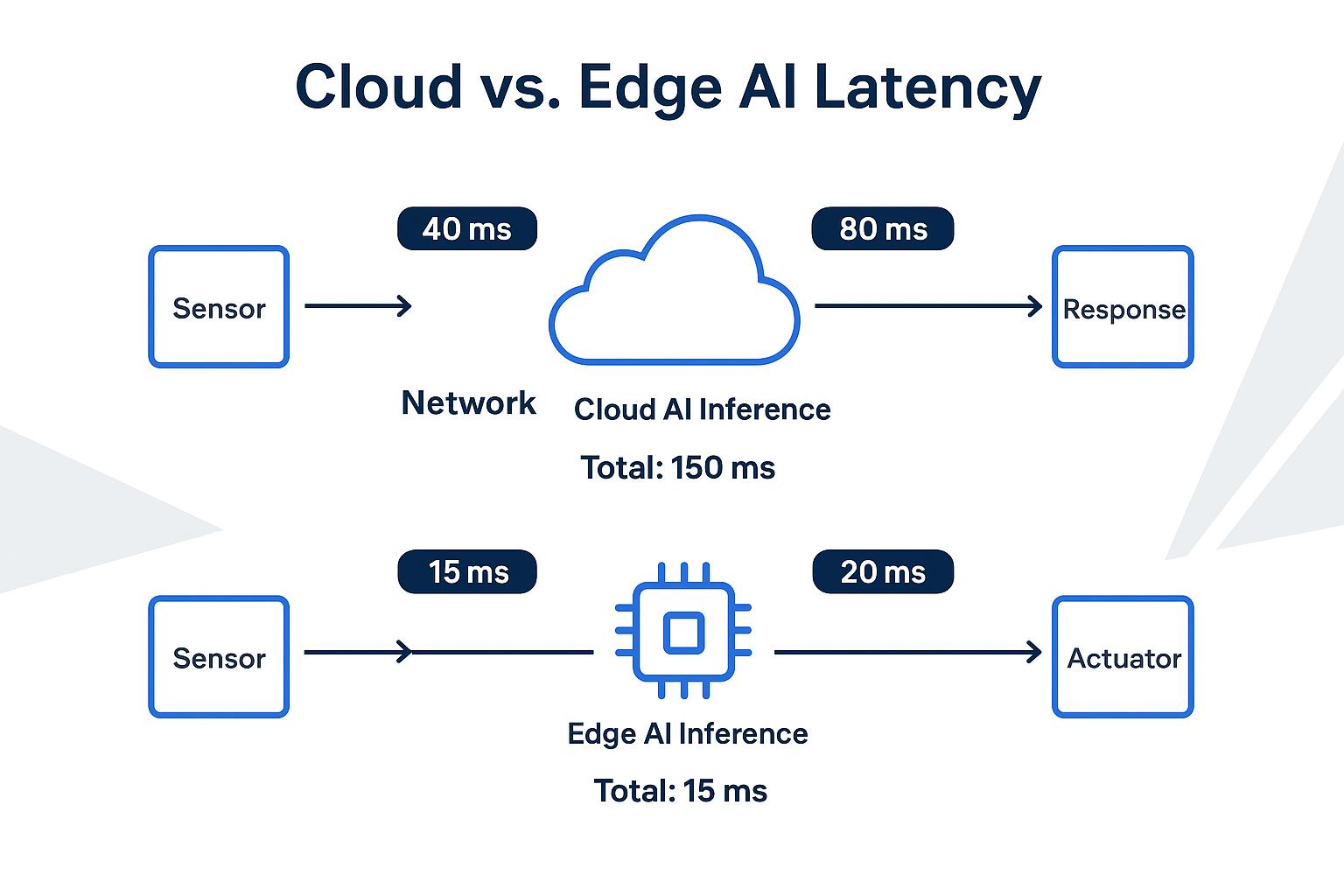
Most robotic systems today are designed around a centralized model: sensors capture data, send it to the cloud, an AI model processes it, and then the response is sent back to the robot.

On paper, this seems efficient; cloud AI offers powerful processing capabilities, massive datasets, and centralized control.
But in practice, this architecture introduces significant time delays that make it unsuitable for real-time control in hazardous conditions.

Here’s what those delays look like in real terms:

Breaking the entire process out into each component:

StageTypical Time (ms)Description
Sensor capture & transmission2–5 msTime for the robot’s sensors to send raw data to the network interface
Network routing to cloud (4–6 hops)30–50 msEven within telecom-controlled networks (like Verizon/Bell), practical round-trip times average 40–50 ms
AI inference in cloud20–100 msDepending on the neural model size and image resolution (e.g., ResNet or YOLOv8 processing multiple frames)
Response transmission back to robot20–30 msNetwork return latency
Total decision latency70–180 msCumulative impact before the robot even begins to act

Now, compare that to a robot with onboard (Edge) AI inference:

StageTypical Time (ms)Description
Sensor capture2–5 msLocal to the hardware
Onboard inference (with Coral TPU or Jetson Nano)10–20 msOptimized local model execution
Motor actuation1–2 msDirect local control
Total decision latency13–27 msImmediate response loop—up to 10× faster than cloud-based models

Why AI Edge Matters for Hazardous Robotics

In hazardous robotics, for example, underground inspection, firefighting drones, and chemical plant maintenance, conditions can change faster than cloud-based AI can respond.
A 40 ms delay might not seem long, but at a drone speed of 10 m/s (36kph), that’s 40 cm of flight before correction, far enough to clip a wall or miss a detection.

Beyond speed, network reliability in these environments is unpredictable. Structural obstacles, electromagnetic interference, and even heat gradients can cause connectivity drops.
Beyond the performance improvements, an edge-based system provides autonomy when connectivity fails.

Case Example: Autonomous Inspection Robots

Imagine an inspection robot navigating a refinery to detect gas leaks or structural defects.
Its onboard camera captures thermal and visual data. Locally trained neural networks (e.g., MobileNet or YOLOv8 Nano) identify anomalies in real time.

If AI inference were cloud-based, even a 150 ms total delay could mean the difference between identifying a small leak and missing a rupture.
By running inference on-device, the robot can stop, alert operators, and contain risk in less time than a blink of an eye.

Even with advanced mobile infrastructure, such as cloud nodes embedded within telecom networks, measured latencies remain around 40–50 ms in ideal conditions.
This demonstrates that physical distance, routing layers, and shared network load still introduce unavoidable delays.

Edge AI in Manufacturing: The Same Logic Applies

Edge AI isn’t just for hazardous fieldwork.
In modern manufacturing lines, where robotic arms operate near human workers, safety interlocks and collision detection systems also depend on sub-30 ms response times.

Cloud AI simply cannot guarantee deterministic response times in those environments.
Edge inference—running locally trained, lightweight neural nets on embedded accelerators—ensures that human safety remains uncompromised.

The Bigger Picture: A Hybrid Future

While cloud AI remains essential for large-scale data aggregation, model retraining, and analytics, the decision loop must move to the edge.

The future is a hybrid model:

  • The cloud trains and refines.
  • The edge acts and learns locally.
  • Together, they balance intelligence and autonomy.

Edge AI transforms robotics from being connected to being aware.

Final Thoughts

In robotics, milliseconds define outcomes.
Whether it’s saving a worker from harm, detecting a gas leak, or preventing a collision, latency is not a luxury metric, it’s the heartbeat of autonomy.

Edge AI ensures that robots can make split-second, context-aware decisions without waiting for the cloud to think.
That’s not just an optimization it’s survival engineering.

Author’s Note:

This article is part of an ongoing series exploring the intersection of AI, IoT, and Edge Computing.
Future articles will examine how hybrid learning models and real-time federated updates will redefine autonomy in both industrial and consumer applications.

The Joy of Giving Back at Canada’s Largest Ribfest

Over the Labour Day weekend, I had the privilege of volunteering at Canada’s Largest Ribfest, once again as Beverage Tent Captain.

Running the beverage tent is always one of my highlights of the year. The energy, the pace, and the teamwork make it something special. It is about much more than serving drinks, it’s about the moments in between. Swapping stories with fellow volunteers, laughing together during the busiest stretches, and celebrating the small wins as a team.

What struck me most this year was the range of people I got to work with. Volunteering introduces you to people from all walks of life, people you might never cross paths with otherwise. And yet, when you’re shoulder to shoulder making things happen, you connect in such a genuine way. Those connections are what make me come back every year.

Rotary’s ideal of “Service Above Self” comes to life in that tent. Every shift feels like a mix of accomplishment, community spirit, and friendship. And when you step back at the end of the weekend, you realize the impact goes far beyond the beverages, it’s about strengthening the bonds in our community while supporting causes that matter.

It’s an experience that leaves you tired in the best way, proud of what was achieved, and grateful for the people you shared it with.

Friendship. Service. Accomplishment. That’s the spirit of volunteering at Ribfest.

Listening Beyond the Obvious: Servant Leadership in Practice

One of the most powerful lessons I’ve learned as a leader is that solving problems rarely begins with technology or process diagrams. It begins with listening, carefully and without assumption.

Whether the “customer” is external, as in my time at BlackBerry, or internal, as at Mabel’s Labels, the turning point always came when I stopped trying to fix things from behind a desk and instead immersed myself in the reality of the people I was serving.

When BlackBerry’s Strength Wasn’t Enough

At BlackBerry, we knew we had built the perfect enterprise tool, that solved a crucial need for the customers. Technically, it was robust and reliable. But adoption was slower than expected. Meetings with customers didn’t immediately reveal the issue, because everyone agreed the BlackBerry Enterprise Server was solid.

The breakthrough came when we shifted from presenting solutions to asking questions “How are you actually using this? What slows you down? What would make your day easier?

That shift uncovered something we hadn’t seen: the real barrier wasn’t the tool’s capability, but the way it fit into their existing workflow. We had to adapt, not by reengineering everything, but by integrating seamlessly into what customers were already doing. That willingness to listen and adjust made all the difference.

Customer confidence soared, simply because I chose to listen to them and not create what I thought they wanted.

When the Customer Was Right There in the Building

At Mabel’s Labels, the “customers” we needed to serve were sitting just down the hall: our manufacturing team.

We were facing a persistent and frustrating issue. End customers were occasionally receiving the wrong order, or incomplete orders with parts missing. Our system at the time forced manufacturing to reprint entire orders when mistakes happened, creating chaos and waste on the production floor.

We held meetings, looked at reports, and brainstormed fixes. We had some ideas, but nothing concrete until we spent a few days in the facility itself. Only by standing alongside the manufacturing team, watching the pace and pressures of their work, did we finally see what they were experiencing.

The solution wasn’t complex. We introduced barcodes for each part of an order, with the order number embedded. Scanners at every station ensured that the right parts matched the right orders. And to keep everyone aligned, we installed a large monitor displaying each order and the components still outstanding.

What looked like a small change reduced our errors dramatically — from 7% to less than 0.1%. More importantly, it gave the manufacturing team confidence and control in their work.

Servant Leadership in Action

Both of these experiences reinforced a core belief: leadership isn’t about the leader. It’s about enabling others to succeed.

Servant leadership means setting aside assumptions, asking questions without ego, and sometimes literally walking the floor to understand what’s really happening. It’s not glamorous work, but it is transformative.

The results smoother workflows, happier teams, and dramatically improved outcomes all speak for themselves.

Why This Matters

Technology will keep changing. Processes will keep evolving. But the ability to listen, adapt, and serve the real needs of customers, whether external or internal is timeless.

That’s the leadership I strive to practice: not telling people what they need, but discovering it with them.